
The Reassigned Numbers Database: How It Works and When It Protects You
· 8 min read
What happens when someone gave you consent to text them, then changed numbers, and the new owner of that number sues?
That's the problem the FCC's Reassigned Numbers Database, or RND, was built for. Phone numbers get recycled constantly. When a customer drops their line, the carrier eventually hands that number to someone else, and that new person never agreed to hear from you. Under the TCPA, their lack of consent is what counts.
The RND gives callers a way to check whether a number has been permanently disconnected since the date they got consent. Used correctly, it also gives them a legal safe harbor. Used carelessly, it doesn't help much at all. Here's how it works in practice. As always, this is general information and not legal advice.
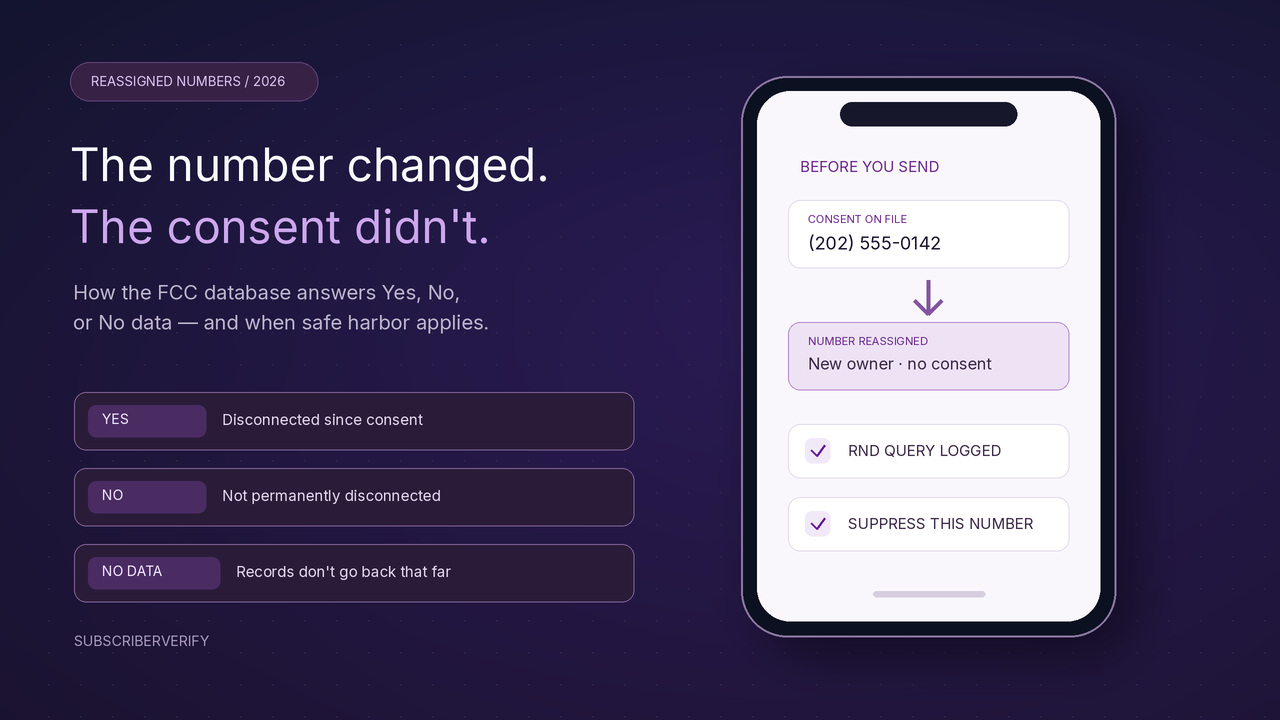
Short answer. You submit a number and a consent date through your verification platform or an RND database provider. Yes means the number has been permanently disconnected since that date, so it may now belong to someone else. No means it hasn't. No data means the database can't say. The safe harbor in 47 C.F.R. § 64.1200(m) only helps if you had consent, you checked the most recent data, and the database incorrectly answered "No." Use of the RND is not mandatory.
How the database answers
You submit a phone number and a date, typically the date you obtained consent. The database answers in one of three ways:
| Answer | What it means |
|---|---|
| Yes | The number has been permanently disconnected since the date you submitted, so it may now belong to someone else. |
| No | The number has not been permanently disconnected since that date. |
| No data | The database can't say, often because the date you gave is earlier than the records go back. |
Scroll sideways on a phone to see both columns.
That's the whole function. It doesn't tell you who owns the number now, whether it's a cell phone, or whether it's on a Do Not Call list.
Where the database came from
The FCC adopted the RND rules in 2018 and the database went live on November 1, 2021. Voice providers report permanently disconnected numbers every month, and by October 2021 the database already held more than 150 million numbers. Callers and their agents register in order to run queries.
The safe harbor, read carefully
The safe harbor is in the FCC's rules at 47 C.F.R. § 64.1200(m). To use it, a caller has to show three things:
- It had consent from the intended recipient.
- It, or its authorized agent, checked the most recent version of the database before calling.
- The database answered "No" when the right answer was "Yes."
A few consequences follow from that wording, and they trip people up.
The burden is on you. If you're sued, you have to prove the query happened, what you submitted, and what came back. A screenshot from memory won't do. You need logged query records tied to each number and each send.
It only covers database errors. If the RND said "Yes" and you called anyway, or you didn't check at all, there's no protection. It also only covers the FCC's database. When it adopted the rules, the Commission declined to extend the safe harbor to commercial reassigned-number products. Private tools can still be useful, but they don't give you this specific defense.
And the check has to be recent. The rule refers to the most recent numbering information reported to the administrator, which is why most teams that rely on it query before each campaign rather than once a quarter.
What it costs
Access is usually a prepaid subscription. Approximate market pricing in 2026 runs from about $8 a month for 1,000 queries up to about $28,000 a month for 50 million queries. A few points along the way:
| Queries per month | Approximate price |
|---|---|
| 1,000 | About $8 |
| 10,000 | About $60 |
| 50,000 | About $280 |
| 500,000 | About $2,000 |
| 2,000,000 | About $3,200 |
| 50,000,000 | About $28,000 |
Scroll sideways on a phone to see both columns.
These are approximate market rates for budgeting, not a quote. Longer terms are often discounted, and prices move, so treat the range as a guide.
Is the RND required?
No. The administrator's own FAQ says use of the database isn't mandatory. Nobody fines you for skipping it. The incentive is the safe harbor, and of course not calling strangers who never agreed to hear from you.
Whether it's worth it depends on how you call and text. If you're working with consent you collected recently and contact people regularly, reassignment risk is relatively low. If you're messaging a list built over several years, or reviving dormant leads, it's much higher. Numbers that sat quiet for two or three years are exactly the ones most likely to have changed hands.
How a reassigned-number case usually starts
These cases tend to follow a pattern. A customer signs up for appointment reminders in 2021. In 2023 they switch carriers and get a new number, and the old one sits unused for a while before the carrier assigns it to someone else. Your system still has the old number and keeps sending reminders, or worse, promotional texts.
The new owner replies "wrong number," which an agent may or may not log. The messages keep coming. A few months later, a lawyer sends a demand letter or files suit. The FCC's consent revocation rules, which took effect in April 2025, say consumers can revoke consent by any reasonable means, so a reply like that is risky to ignore.
What makes these cases difficult isn't the first message. It's the pattern after it. In many jurisdictions, courts have treated the original consent as belonging to the person who gave it, not to the phone number, so the new owner never consented at all. Under the FCC's rules, one call to a reassigned number used to have a limited one-call safe harbor, but the D.C. Circuit struck that down in 2018. The RND safe harbor replaced it.
Getting the date right
The single most common mistake with the RND is submitting the wrong date. The query asks whether the number was permanently disconnected after a given date. If you submit today's date, you'll almost always get "No," which tells you nothing useful and won't support the safe harbor.
The date you submit should be the date you obtained consent from the person you meant to reach, or the most recent date you can confirm they still had the number. If your CRM doesn't store a consent date per number, that's the first thing to fix. If you bought leads, ask the seller for the consent timestamp before you rely on the RND.
Where the RND fits with other checks
The RND answers one narrow question. A full pre-send process usually asks several more, and the order matters.
Take a lead from 2023 with a 404 area code. The RND might say "No," so it hasn't been permanently disconnected, but that doesn't mean it's a good number today. It might be temporarily suspended. It might now be a landline that can't receive texts. It might be on the federal Do Not Call list. Its owner might have moved from Atlanta to Phoenix, which changes their local time and which state's rules apply.
That's the gap SubscriberVerify fills alongside the RND. A pass through the bulk phone validator returns line type, carrier, deactivated status and location, and the location algorithm doesn't rely only on the area code. Deactivated-number data is a good early warning, since a number that's been cut off is the step before it gets reassigned. We wrote more about that in should you text deactivated numbers. The same file can include a DNC check and known-litigator matches; see litigator scrubbing and how to verify phone numbers for the rest of that workflow.
The two work well together. Use SubscriberVerify to clean the list and catch dead, landline, DNC and litigator numbers, then run the remaining consented numbers through the RND for the safe harbor. Keep the logs from both.
How often numbers are reassigned
The FCC's own records give a sense of scale. Providers began reporting permanently disconnected numbers in April 2020, and by May 2021 the database held more than 102 million numbers. Five months later it was over 152 million. Not every disconnected number gets reassigned, and the database includes numbers that may sit idle for a long time, but the volume shows how quickly a list ages. A file that was clean three years ago almost certainly isn't today.
That's also why freshness matters for any list you didn't build yourself. If a lead seller can't tell you when consent was collected, you can't run a meaningful RND query, and you can't really judge how many of those numbers still belong to the person who filled out the form.
Recordkeeping that actually holds up
If you're going to rely on the safe harbor, design your records around a future lawsuit. For each number, store:
- The consent date and source
- The RND query date
- The date you submitted to the database
- The response
- The send timestamp
Keep them for at least as long as the TCPA's four-year statute of limitations.
Teams that do this well tend to automate it, querying through the API right before a campaign goes out and writing the response next to the send record. It's dull work. But in a wrong-number case, it's often the difference between a quick dismissal and a long settlement conversation.
Clean the list before you query the RND. See which numbers are mobile, landline, VoIP, or deactivated, and screen for DNC and known litigators in the same file. Bulk Phone Validator DNC Screening
