
TCPA Lawsuit Statistics for 2026: What the Numbers Say
· 9 min read
How many TCPA lawsuits are actually filed, and how worried should you be about them?
Most answers online either inflate the number to sell something or wave it away. The most widely cited public count comes from WebRecon, which tracks lawsuits filed in federal court each month under the TCPA, the FDCPA and the FCRA. Here are its latest figures, through September 2026, with a link to the report behind every number.
The key numbers
| Measure | Figure | Source |
|---|---|---|
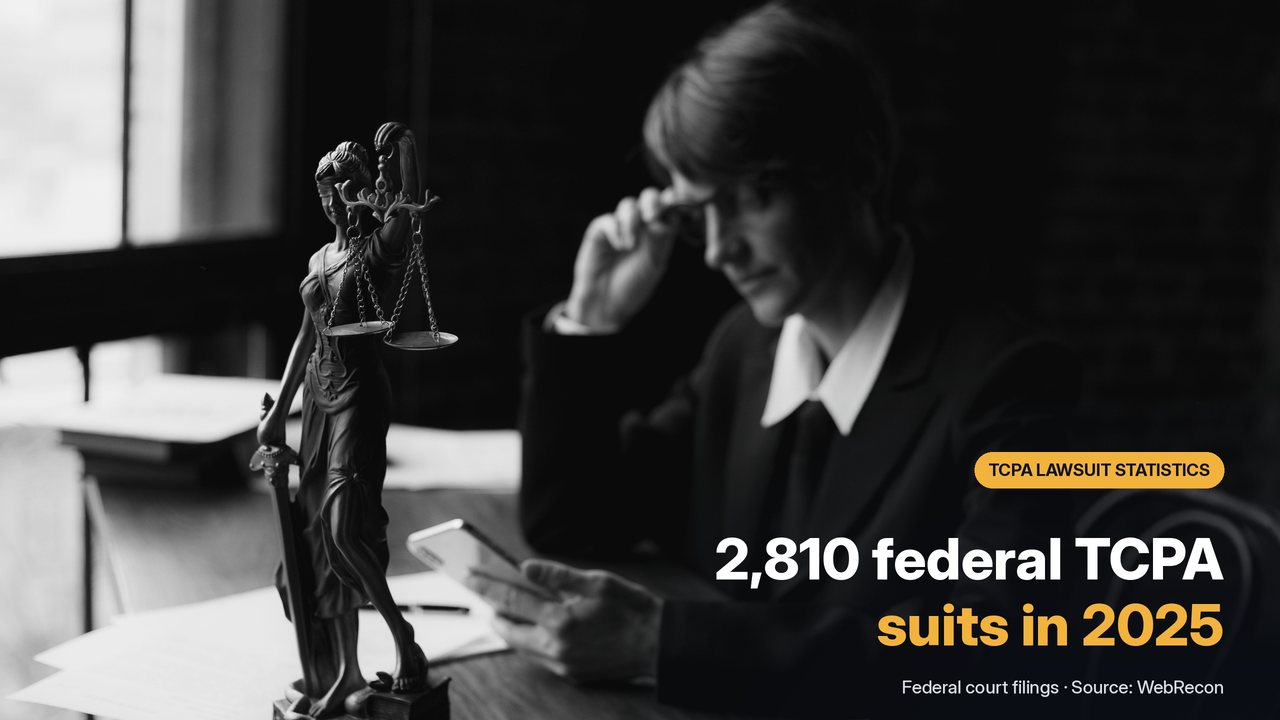
| TCPA suits filed in federal court, full year 2025 | 2,810, up 0.8% from 2,788 in 2024 | WebRecon, Dec 2025 |
| TCPA suits filed, January to September 2026 | 2,096 | WebRecon, Sep 2026 |
| Filed as putative class actions, September 2026 | 68.6% (131 of 191) | WebRecon, Sep 2026 |
| Highest monthly class action share in 2026 | 80.0% in May (216 of 270) | WebRecon, May 2026 |
| Busiest month of 2026 so far | April, 330 TCPA suits | WebRecon, Apr 2026 |
| Plaintiffs who had sued before (TCPA, FDCPA and FCRA combined), September 2026 | 37% (497 of 1,354) | WebRecon, Sep 2026 |
| Statutory damages per violation | $500, up to $1,500 if the court finds it willful or knowing | 47 U.S.C. § 227(b)(3), (c)(5) |
Scroll sideways on a phone to see every column.
What the count covers, and what it misses
WebRecon counts lawsuits filed in US District Courts. That leaves out a lot:
- State court cases. Claims under state laws such as Florida's or Oklahoma's are often filed in state court and won't show up.
- Arbitration demands and demand letters that settle before anyone files.
- Revisions. WebRecon updates earlier months as new filings are coded, so a month's total in a later report can differ from the first one published.
Treat the figures below as a consistent measure of federal filings, not a census of every TCPA claim.
TCPA lawsuits by year
| Year | TCPA suits | Change | Source |
|---|---|---|---|
| 2021 | 1,708 | Down 48.3% (WebRecon's figure) | Dec 2021 report |
| 2022 | 1,531 | Down about 10% | Dec 2022 report |
| 2023 | 1,683 | Up about 10% | Dec 2023 report |
| 2024 | 2,788 | Up about 66% | Dec 2024 report |
| 2025 | 2,810 | Up 0.8% | Dec 2025 report |
Totals are as published in each year's December report. Changes other than 2021 are our arithmetic from those totals, so they can differ slightly from the percentages WebRecon quotes after revisions.
Two things stand out:
- 2024 was the big jump. Filings rose by roughly two-thirds in one year, and 2025 held at that level.
- It isn't an all-time record. WebRecon's reports for 2019 and 2020 each show more than 3,200 TCPA suits for the year. Filings fell sharply in 2021, the year the Supreme Court narrowed the TCPA's autodialer definition in Facebook v. Duguid, and only recovered in 2024.
2026 month by month
| Month | TCPA suits | Class actions | Class share |
|---|---|---|---|
| January | 219 | 170 | 77.6% |
| February | 292 | 211 | 72.3% |
| March | 283 | 220 | 77.7% |
| April | 330 | 255 | 77.3% |
| May | 270 | 216 | 80.0% |
| June | 250 | 191 | 76.4% |
| July | 177 | 108 | 61.0% |
| August | 198 | 143 | 72.2% |
| September | 191 | 131 | 68.6% |
Each row is from that month's WebRecon report, as first published. The rows add up to 2,210, more than the 2,096 year-to-date total in the September report, because WebRecon revises earlier months.
- Spring was the peak. February jumped 33.3% over January, and April's 330 suits were the year's high.
- July fell hard. Filings dropped 29.2% from June, the steepest monthly fall of the year.
- Late summer stayed lower. August rose 11.9%, then September slipped 3.5% to 191.
Is 2026 up or down?
That depends on which WebRecon report you read.
- The September 2026 report says TCPA filings are up 13.4% year to date.
- But the September 2025 report listed 2,128 TCPA suits for January to September 2025, which is slightly more than the 2,096 counted for the same months of 2026.
- WebRecon doesn't explain the gap. It probably compares against revised 2025 figures, but we can't confirm that from the public reports.
What the counts do show: at 2,096 suits in nine months, 2026 is running at about 2,800 for the year (our arithmetic). That's roughly level with 2024 and 2025. The year-to-date growth WebRecon reported has also narrowed every month since June, from 34.3% to 13.4%.
Why the class action share matters most
Compare two companies, each sued once this year:
- Company A called one man on the Do Not Call list four times. He sues on his own. The claim is worth a few thousand dollars and settles quickly.
- Company B sent a promotional text to 40,000 people, some of whom were on the registry. A lawyer files on behalf of everyone in the same position.
Both count as one TCPA case. The second can be worth millions, because statutory damages of $500 per violation, or up to $1,500 if a court finds the conduct willful or knowing, apply to every message sent to every class member.
That's why the class action share matters more than the total. Through 2026 it has ranged from 61.0% to 80.0% a month. WebRecon called the 68% share in December 2025 "extraordinarily high, historically speaking," and in December 2024 it reached 85.3%. For comparison, the share was 26.5% in December 2019. Many class cases settle or end without certification, but getting there is expensive.
Repeat plaintiffs and busy law firms
Every WebRecon report includes the share of plaintiffs who have sued before. It covers all three statutes, not just the TCPA, but the pattern is consistent:
- 37% of September 2026 plaintiffs had filed a consumer suit before. Together, those 1,354 plaintiffs had filed about 11,211 lawsuits since 2001 (September 2026).
- 44% of December 2025 plaintiffs were repeat filers (December 2025).
- One South Florida attorney, Gerald Lane, represented 820 consumers in 2025 and 504 in 2026 through September, the most of any attorney in both periods (2025, 2026).
- Counting TCPA cases only, CompliancePoint's 2025 review found that 397 serial plaintiffs, 24.7% of all filers, accounted for 54.0% of the cases it tracked.
We've covered how this works in practice, from who counts as a professional litigator to the burner phones used to generate claims.
What's driving the filings
WebRecon doesn't break cases down by legal theory, so this section relies on court decisions and statutes rather than counts.
- Quiet hours. The FCC's rule bars telephone solicitations before 8 am or after 9 pm in the recipient's local time (47 C.F.R. § 64.1200(c)(1)). Plaintiffs have used it against marketing texts, often sent to people who had subscribed. In King v. Bon Charge (D. Del., April 30, 2026), the court dismissed a quiet-hours claim because the plaintiff had opted in by texting a keyword. That's one district court, so it isn't binding elsewhere. Our quiet hours by state guide covers the state windows, which are often narrower.
- Do Not Call texts. Texts to numbers on the national registry remain a common claim. In July 2026, the Seventh Circuit held in Steidinger v. Blackstone Medical Services that texts aren't "telephone calls" under the TCPA's Do Not Call private right of action. That ruling binds federal courts in Illinois, Indiana and Wisconsin. Courts elsewhere aren't bound by it, so it's risky to rely on. Our TCPA text message rules cover consent and opt-outs.
- State mini-TCPAs. Florida's amended Telephone Solicitation Act (2021), Oklahoma's Telephone Solicitation Act (in force November 1, 2022) and Maryland's Stop the Spam Calls Act (in force January 1, 2024) all give consumers a private right of action. Texas SB 140, effective September 1, 2025, extended the state's telephone solicitation rules to texts and made more violations actionable under its consumer protection law. See our mini TCPA laws by state for the details.
- Wrong and reassigned numbers. Someone gave consent years ago, the number changed hands, and the new owner never agreed to anything. The FCC's Reassigned Numbers Database exists for exactly this problem.
Where cases are filed
Consumer suits under all three statutes were filed in 158 different federal court branches in September 2026. The busiest courts that month were:
- Northern District of Georgia, Atlanta: 153 suits
- Northern District of Illinois: 84
- Central District of California, Los Angeles: 77
- Central District of California, Santa Ana: 58
- Middle District of Florida, Tampa: 50
Those rankings come from the September 2026 report and cover FDCPA and FCRA cases too. FCRA cases (1,083 that month) far outnumber TCPA cases (191), so the list tells you more about credit reporting suits than TCPA ones. The broader point holds: TCPA risk isn't limited to one or two hotspots. If your list is heavy in states with their own telemarketing laws, your exposure can be higher than the national totals suggest.
Why other sources show different numbers
| Source | 2024 | 2025 | Change |
|---|---|---|---|
| WebRecon | 2,788 | 2,810 | Up 0.8% |
| CompliancePoint | 1,641 | 2,628 | Up 60.1% |
Scroll sideways on a phone to see every column.
Same statute, same year, and one source shows a flat year while the other shows a 60% surge. Neither is necessarily wrong. Trackers differ on which courts they include, how they treat cases with several defendants, and when they count a case. If you quote these numbers internally, pick one source, use it consistently and say what it counts. Mixing them is how a 1% rise turns into a 60% rise on a slide.
Reading the numbers for your own risk
About 2,800 federal suits a year, spread across every business that calls or texts consumers, isn't a high rate on its own. The risk concentrates on companies that:
- send at high volume, where one mistake becomes a class;
- text purchased or aged lists;
- message near the edge of the allowed hours;
- keep contacting people who have asked them to stop.
So the more useful question isn't how many lawsuits there are. It's which of your numbers are most likely to produce one. That usually comes down to a short list: numbers on federal or state DNC lists, numbers that were disconnected or reassigned after you got consent, numbers in states with stricter rules, and numbers tied to people who sue often.
SubscriberVerify's bulk phone validator checks most of these in one pass. It returns line type, carrier and deactivated status, and its location algorithm doesn't rely only on area code, which matters when a state's calling window depends on where the person actually is. The same file can include a DNC check and litigator scrubbing. None of that replaces consent records, but it removes the numbers that most often turn a routine campaign into a demand letter.
Defense costs belong in the picture too. Even a case that ends early can mean months of requests for consent records, dialer logs and vendor contracts. Companies that can produce clean records quickly tend to resolve cases faster and for less.
When the next numbers come out
WebRecon publishes each month's figures a few weeks after the month ends. The August 2026 report is dated September 23 and the September report October 22. As of November 16, 2026, the October report isn't out yet. We'll update this page when it is.
Figures are from the WebRecon, CompliancePoint, court and statute sources linked above, checked on November 16, 2026. This article is general information, not legal advice.
